
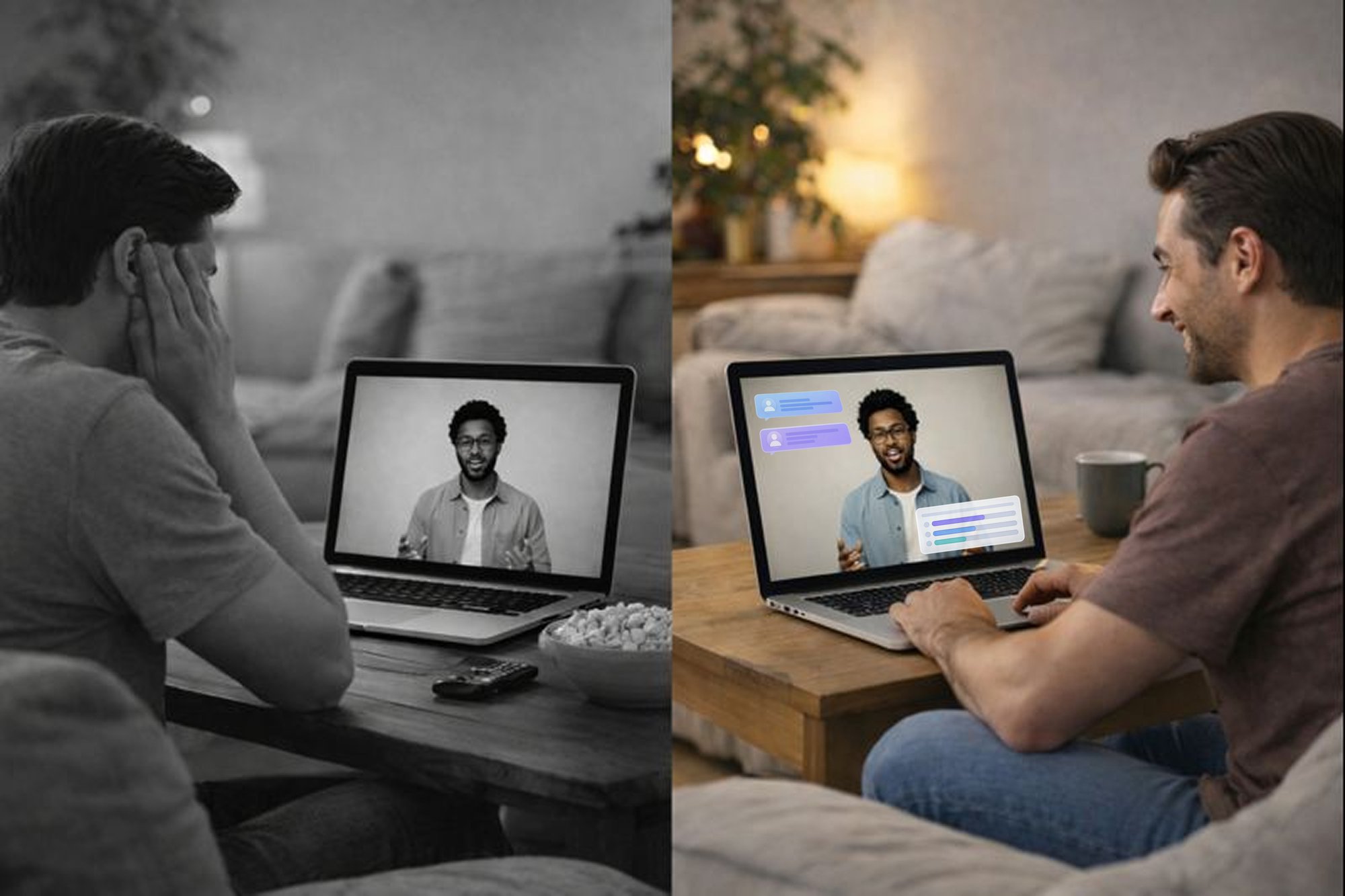
The Engagement Drop-Off: Why Viewers Watch but Don’t Join In
Daniella BondarLivestreams are good at attracting attention, but participation is where many of them fall short.
It’s common for live events to rack up views, solid watch time, and even positive feedback, while the chat stays quiet. Viewers are present, but they aren’t involved. This disconnect is what we call the engagement drop-off: the moment where audiences shift from active participants to passive watchers. And it has far less to do with audience interest than most teams think.
What the Engagement Drop-Off Really Is
The engagement drop-off happens when viewers consume a livestream passively instead of interacting — even when the content is relevant and well produced.
This doesn’t happen because people don’t care. It happens because participation feels unclear, unnecessary, or too effortful in the moment.
Watching is easy. Engaging requires a signal.
Why Viewers Stay Quiet, Even When They’re Interested
The engagement drop-off shows up when livestreams unintentionally send the message that interaction is optional, disruptive, or secondary to the main content.
Here’s where that message comes from.
1. Participation Isn’t Expected
If a livestream opens like a presentation, viewers treat it like one.
When no one invites participation early, people assume:
- Questions will interrupt the flow or be ignored
- Engagement isn’t part of the experience
Once viewers settle into passive mode, it’s difficult to pull them out later.
2. Prompts Are Too Open-Ended
“Any thoughts?” sounds friendly, but it creates hesitation.
Viewers don’t know how to respond. What kind of response is expected? How much should they say? Will anyone even notice?
Unclear prompts accelerate the engagement drop-off by increasing the perceived effort of speaking up. Clear, directive prompts make participation feel safe and easy.
3. There’s No Feedback Loop
Engagement relies on acknowledgment.
When viewers send messages, respond to polls, or react in chat but don’t see their input reflected back on screen or referenced by the host, they stop trying.
The engagement drop-off grows when interaction disappears without a trace.
4. Flow Is Prioritized Over Interaction
Many hosts worry that pausing for engagement will slow things down or feel awkward. So they keep moving.
But livestreams that never make room for interaction quietly train audiences to stay passive — even when they’re interested.
What Reversing the Engagement Drop-Off Looks Like in Practice
It’s tempting to blame low engagement on shy audiences, distracted viewers, or “low energy.” But the engagement drop-off usually isn’t a behavior problem. It’s a design problem.
Reversing it is the responsibility of the event creators, producers, and hosts. Participation doesn’t happen by accident. It has to be invited, guided, and reinforced throughout the live experience.
Engagement needs to happen before viewers settle into passive mode. A simple prompt in the first few minutes sets the expectation that this isn’t just something to watch — it’s something to take part in.
From there, participation needs to be easy. Clear, direct prompts outperform open-ended questions every time. Polls, guided chat questions, and simple calls to action give viewers direction and remove the friction of figuring out how to engage.
Visibility matters just as much. When audience input stays buried in the chat, engagement fades quickly. When responses, messages, and poll results are brought on screen, participation feels meaningful. Viewers can see the impact of their input in real time.
Acknowledgment closes the loop. Hosts don’t need to respond to everything, but they do need to respond to something. Even a brief callout or on-screen highlight signals that participation is noticed and valued.
None of this requires heavy production. It requires intention — and the right moments built into the flow of the event.
Designing Livestreams for Interaction
Effi is designed to support a participation-first approach to livestreaming.
By making it easy to surface chat overlays, curate audience messages, and create polls with clear directives, Effi helps producers and hosts guide interaction without disrupting the stream. Engagement becomes part of the experience, not an extra task layered on top.
When interaction is designed early, made visible, and acknowledged in real time, the engagement drop-off doesn’t need to be forced closed. It resolves naturally.
Why Closing the Engagement Drop-Off Changes Everything
Livestreams don’t fall flat because people don’t care. They fall flat because people aren’t clearly invited in.
When participation is intentional — when viewers know what to do, when to do it, and that it matters — engagement follows naturally. Energy builds. Conversations emerge. And the livestream becomes something people remember, not just something they watched.